The Bullet Train Always Tells the Truth: Brazil's Most Reliable Reality Check
It is early 1973 and Japan is sending 26 directors from Mitsubishi to Brasília to meet President Médici — the largest of several Japanese missions that same year. On the agenda is $1.2 billion in investments over five years across petrochemicals, shipbuilding, mining, and food. The group's leader, Chujiro Fujino, meets with Médici for fifteen minutes at the Palácio do Planalto, then tells reporters: “We didn't come here to discuss or study matters. We came to make deals.” Decisions that might take a year or two, he adds, will be made in six months [1]. A country of semiconductors and shinkansen (bullet trains) had come calling on the country of the future.
Over the years that followed, Japanese technical missions continued in earnest, despite the downturn in the economy. In 1975, Japanese railway specialists arrived to plan the Ferrovia do Aço between Belo Horizonte and São Paulo; months later, Japan National Railways and a Japanese cooperation agency conducted a 20-day tour of Brazilian rail facilities and delivered a 515-page technical report from Tokyo; and late that year, a Japanese railway technical mission visited Vale do Rio Doce in Vitória. All of this was strictly practical and technical, focused on Brazil’s real infrastructure needs, not its wants.
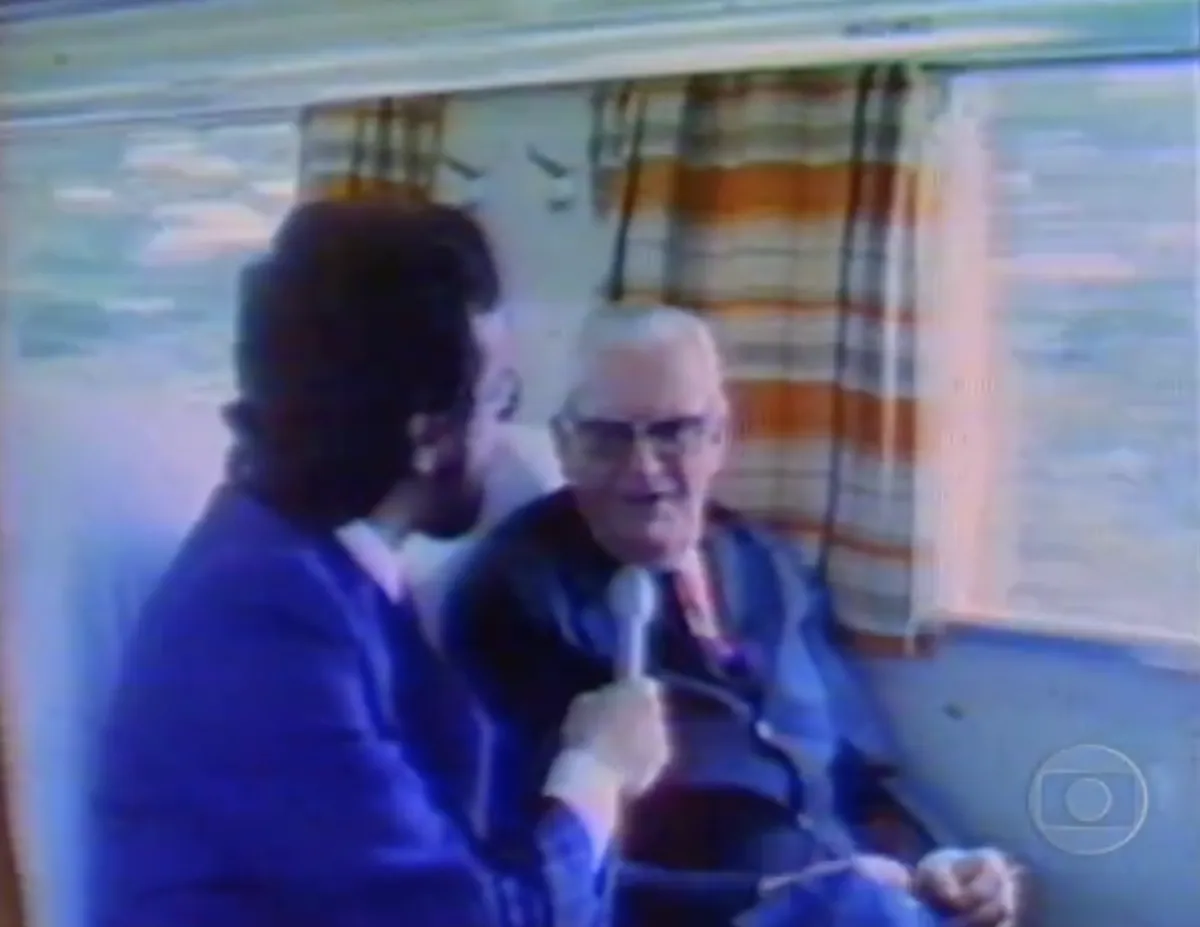
In late 1976, President Geisel visits Japan in the middle of the largest export/financing negotiation in Brazilian history, where he happens to ride the shinkansen as part of the official program. The Rio - São Paulo bullet train gets embedded in a multi-billion dollar package of deals as one commitment among many. It’s the foundation of a new Brazilian foreign policy toward the Far East.
Japan is described in the Brazilian media as the ideal market for Brazilian raw materials and manufactured goods. Geisel says Japan is today one of the most developed countries in the world and Brazil sees it as a model. Brazil signs what the headline calls the largest export contract in its history. The numbers: $1.5 billion in financing, $1.4 billion in investments from Japanese financial institutions, totaling $2.9 billion (equal more than 10 billion dollars at current prices). Contracts cover Vale do Rio Doce iron ore exports to Japan, the Albrás-Alunorte aluminum project, and the Tucuruí Dam.
In the last three years of the decade, the term “Japanese mission” dries up in Brazil’s top newspapers. The flow of engineers and technical delegations that characterized the first half of the 70’s does not continue. Brazil, much deeper into its crisis, loses the Japanese presence on the ground. The relationship has become transactional — Japan agrees to finance but stops showing up in person.
Two years after Geisel’s visit, Transport Minister Dirceu Nogueira goes to Tokyo with the intention of closing a deal on the purchase of a bullet train. Toshio Doko, the most powerful industrialist in Japan, leads a consortium of 10 companies to win the contract. Japan is deadly serious, but Brazil is already being mocked in its own press. The Jornal do Brasil runs an editorial mocking the Nogueira trip, saying Brazil won’t buy the shinkansen because there’s no money, no rail traffic density to sustain it, and the tunneling costs alone are astronomical. It tells the Ministry what they should be doing instead: go look at the Ferrovia do Aço [2]. Japan wouldn't sell Brazil a bullet train but would finance its freight railways — the relationship settling into the shape it would hold for decades.
Columnist Ari Cunha in Correio Braziliense, in the same week that Nogueira is in Japan, notes the folly of it all: Brazil has trains that run at 40km/h while crashing into each other and invading samba school buildings. He adds: a bullet train running at 210km/h requires a control room with computers tracking every train’s exact position across 2,000 kilometers of line, meteorological detectors, wind and fog sensors — and “here, the train would travel with open doors, as is customary” [3].
Back in Brazil and unrepentant, Nogueira says the bullet train will come in 1984 and that financing is practically resolved via the Bank of Tokyo. The study of economic viability will take 6 months to a year. Brazilian engineering is capable up to the point of laying the rails, after which Japan will be needed. On the demand side, he estimates 80,000 passengers per day on the bullet train [4].
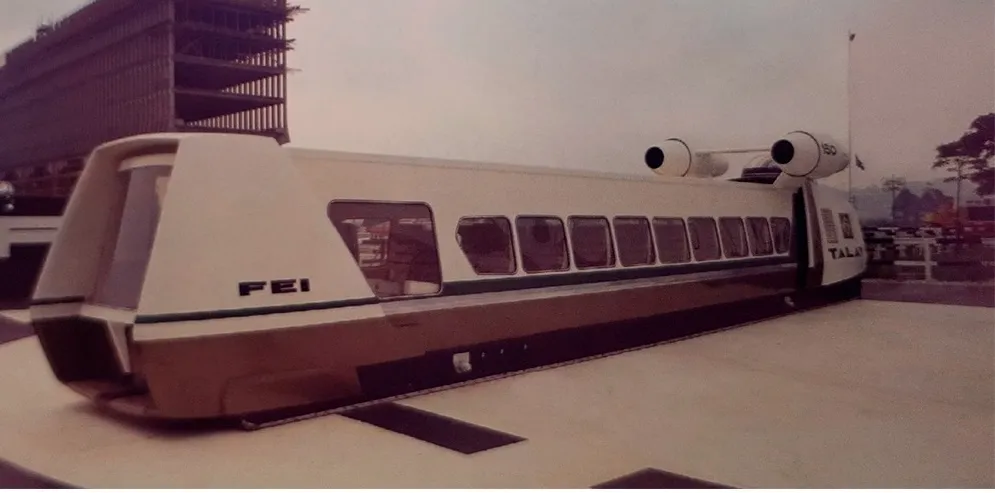
The TALAV, a Brazilian-designed 200km/h prototype commissioned by the same government sits unused in São Bernardo do Campo. Built by professors and students at FEI and displayed at Brasil Export in 1972, it could only carry about 20 passengers, and no one could figure out what to do with it [5]. A test track was never built due to budget cuts and the program ended in 1973. An ex-student noted in recent years that he saw the TALAV rotting away on the FEI campus in 1983.
Brazil in the late 1970s wasn’t a country lacking engineering talent — Embraer was already producing aircraft and FEI was building experimental trains — but one lacking the institutional and political capacity to turn that talent into viable infrastructure. Nogueira flew to Tokyo to buy what Brazil had already half-built at home. In the end, he never signed. His own advisers talked him out of it.
Brazil’s Economic Miracle may have ended in ‘73 but its political-psychological hangover meant that the people in power in ‘78 are the same. The regime that built Itaipu, the Transamazon and Embraer now trying to will one more grand project into existence while the fiscal floor drops out.
The Rio-São Paulo bullet train is also an assertion that the Southeastern axis still is Brazil, over a decade after the capital migrated to the Center-West and a few years after Guanabara was dissolved back into Rio de Janeiro state. These echoes of preconditions are an attempt to spend political capital that’s no longer there.
The bullet train isn't a wish that summons the conditions for its own success. The project surfaces when enough other things are genuinely working — fiscal capacity, institutional seriousness, political stability, foreign confidence. It’s a story of real versus desired self; about where Brazil actually is, not where it says it is. And each failure to launch is the desired self colliding with the real one.
The bullet train resurfaces in the 80s and again in the 90s, as a dream without the preconditions. The 2000s bring the commodity boom, the BRICS moment and even the World Cup and Olympics. The institutional machinery appears amidst these favorable economics — state-owned railroad infrastructure company VALEC chosen to head the working group behind the bullet train’s technical and financial roadmap; the Italplan study promising a $9 billion project funded entirely by private capital; and a high-profile 2010 auction at Bovespa, where nobody showed up [6].
In recent years, the zombie project has resurfaced in a mix of 80s, 90s and 2000s circumstances where the momentum and economics are absent. The PT, which made this a campaign promise in 2007, has spent eighteen years and produced zero kilometers of track. What does exist, however, is a private 99-year concession with TAV Brasil who promises operations by 2032 with no environmental license filed and a retreating Lula, saying the train is “not the government’s project” and it won’t participate in financing.
Economist Cláudio Frischtak says there was an alternative to the bullet train that was much more likely to be green-lit — one that could actually have been built, funded, and running by now. A train that could hit 150km/h during the day, and handle freight at night could've been managed by two concessionaires but Dilma killed it. Thomaz Schoeffel, the director of the ABPF — the Brazilian Association for Railway Preservation, says Brazil’s railway engineering has atrophied so badly that “even our metros aren’t really Brazilian” [7].
The bullet train has always told the truth about Brazil, even when Brazil wasn’t listening. It functions as a recurring stress test — revealing whether the conditions that make a country capable of building its future are actually present, or merely performed.
Sources
Folha de São Paulo — 1973: Grupo japonês da Mitsubishi vai a Brasília e diz querer investir no país, Febuary 6, 2023
Jornal do Brasil — Perda de Tempo, September 05, 1978
Correio Braziliense — Visto, Lido e Ouvido, September 14, 1978
Correio Braziliense — Dyrceu, de Volta ao Brasil, Garante: Trem-bala virá mesmo em 1984, September 19, 1978
Journal Eco Vector — Air Cushion Vehicle (ACV): History Development and Maglev Comparison, 2019
Bang Bang — Um trem para Bangladânia, May 15, 2015
Gazeta do Povo — Trem-bala acumula 18 anos de promessas, R$ 60 bilhões falados e zero kms construídos, January 26, 2026