Hunger as Policy: Diagnosing the Politics of Famine
It took ordinary medical examinations in the factories of 1930s Recife for a young doctor to realize that the city's labor force was being slowly starved to death. When he presented that conclusion to the men who owned the mills, rather than debate his findings, they simply fired him. “I know what my patients have,” Josué de Castro said as he left. “But I can’t cure them because I’m a doctor and not a director here. The sickness these people have is hunger” [1].
That moment defined his life’s work. Born in Recife, Castro grew up between abundance and scarcity — his landowner father, who had fled the great drought of 1877, kept a full table while withholding support for his separated mother. Just beyond the family home on the Capibaribe River lay the mangroves, which he later called his true university. There, men and crustaceans shared a bleak symmetry in the mud — one feeding on the other, the other returning the favor. “These were human beings made of crab meat,” he wrote [2].
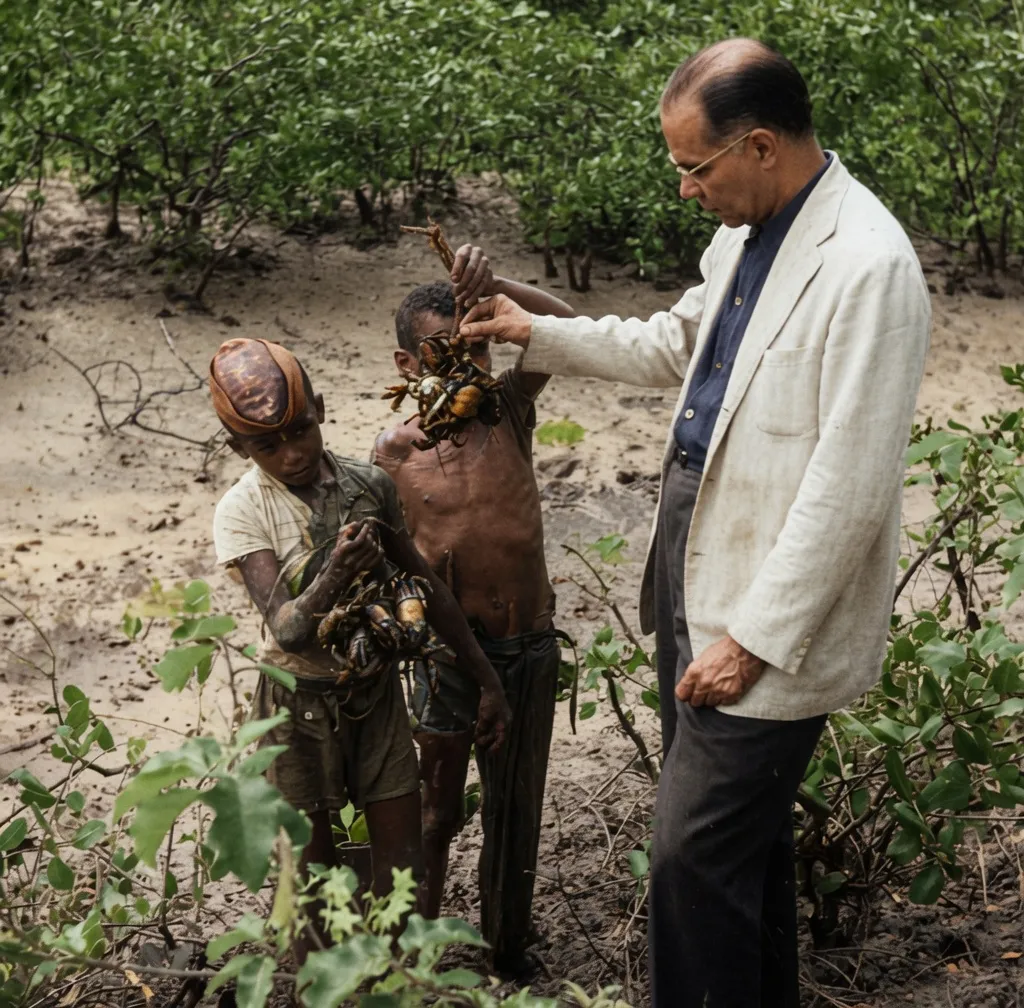
Medicine had come by accident — he had wanted to be a psychiatrist — but the factory episode crystallized the issue as social, not clinical. In 1932 he conducted a survey of working-class conditions in Recife, published three years later as “Vida das classes operárias do Recife”, the country’s first major survey of working-class living conditions. By linking diet directly to productivity, housing, and wages, and rejecting the racial and climatic excuses then in vogue1, he turned his personal observation into something he could measure.
Castro's survey didn't exist in a vacuum. Brazil was already moving toward labor protections — the ILO, a new Ministry of Labor, a 1934 Constitution — and by 1936 that arc produced the country's first minimum wage law [3].
On the other side of the country, São Paulo's Escola Livre de Sociologia e Política conducted a 1934 study of 221 working-class families, of whom 75 kept detailed expenditure diaries to track purchases. It showed that 27% of respondents didn’t earn enough at work to guarantee 2,600 calories daily — considered the bare minimum to survive [4]. While they weren’t favorable numbers, the São Paulo respondents were much better off than those back in Recife, who were averaging just over 1,600 calories, according to Castro's study.
The minimum wage decree took nutrition into consideration and a 1938 law created the 13-item cesta básica, or staple food basket (consisting of meat, milk, beans, rice, flour, potato, pão francês, coffee, banana, tomatos, sugar, oil, and butter). The food basket wasn't just a nutritional concept since, legally, food costs weren’t allowed to fall below the cost of the basket.
By the early 1940s, Castro — the doctor who got fired for naming hunger — was an institutional insider running part of the official response. He founded the Brazilian Society for Nutrition and headed SAPS — Brazil’s state-run social welfare program — while creating a network of subsidized public canteens across the country. The canteens themselves, with a fixed menu and balanced meals, were a direct admission that the minimum wage wasn’t enough to cover basic food costs.
Yet this entire state machinery was deeply unequal by design. Workers in Rio de Janeiro earned nearly two and a half times those in the Northeast — the very region surviving on 1,600 calories a day was anchored to the lowest wage floor. This was the stark, geographic gap between policy and reality.
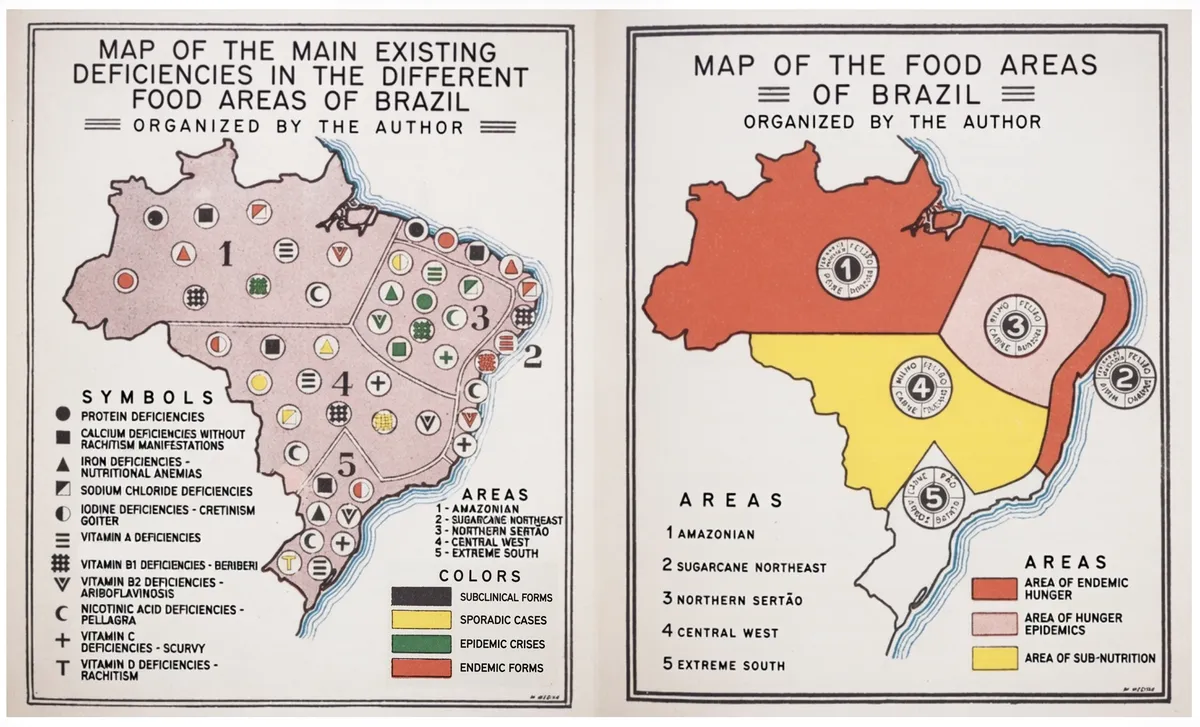
In 1946, Castro published his magnum opus, Geography of Hunger, which did for the nation what his 1932 survey had done for Recife: it mapped hunger as a structural condition, endemic to how Brazil organized land, labor, and food. In his book, he mapped the country into five geographical regions, categorized by diet and nutritional deficiency. The frugal but balanced baseline of the Extreme South (including the Southeast) and Northeastern hinterland, outside of droughts, contrasted sharply with chronic hunger in the Amazon and the Sugarcane Northeast [5].
There, the best agricultural land in the region was locked into a monoculture by a landowning class with no incentive to diversify. People were hungry in fertile territory and clientelism made hunger a political arrangement, not geographic fate. At times, the State went even further. In 1932, the government created seven concentration camps across Ceará to prevent hungry migrants known as retirantes from overwhelming the cities. By April, over 72,000 people had been counted across the camps, while a further 1,800 were confined in the capital, Fortaleza.
Rather than offering relief, the state deployed disciplinary internment to manage the hungry out of sight. Contemporary reports coldly noted that despite an influx of newcomers, "not a single migrant is to be seen on the city's streets" — the camps kept them contained, and once inside, they were forced through daily hygiene routines, from bathing to haircuts [6]. Treating mass displacement as a public order problem produced only emergency containment.
Even though Castro was working from inside the government, the whole system was fragile. Vargas’s political structure collapsed when he fell in 1945, but SAPS continued under changing governments for more than twenty years until it was formally extinguished by the military dictatorship in 1967. The same dictatorship that shut down SAPS also exiled Castro in 1964, silencing both the institution and the man who built it.
With Castro and his nutritional safety nets cleared away, the state dismantled his wage machinery: real wages plummeted by 24% between 1982 and 1990 as the dictatorship systematically underestimated inflation in its wage adjustments, eroding what workers could actually buy.
Yet a financial milestone arrived in 1995, as the stabilization of the Plano Real finally allowed the minimum wage to catch up and once again buy a single cesta básica — meeting a basic survival floor first defined back in 1938, nearly sixty years earlier. That economic stabilization set the stage for targeted social policy, building on local Bolsa Escola experiments from 1995 onward. This momentum eventually culminated in the Fome Zero strategy and the launch of Bolsa Família under Lula in 2003.
Decades after Castro’s exile, his core argument finally became permanent state policy — proving that hunger required structural investment rather than emergency containment. It was an arc that ultimately led to Brazil briefly leaving the UN hunger map in 2014, and to a minimum wage that by 2026 could buy 1.8 cestas básicas.
The distance between those two moments — the camps and the cash transfer — can be measured in a single life. In 2016, a journalist visiting the ruins of the Senador Pompeu concentration camp in Ceará found a rural woman, Maria Danúbia de Souza, living meters away from the camp with her six children, unaware of their ages or even her own. A recipient of Bolsa Família, she had never heard of the camps, even as her simple home fell into decay and her corn and bean crops refused to grow that year [7]. The state had long since abandoned the internment pens, but the ruins and the drought remained. In some regions, the earth still asks for more than it gives, but the welfare cards that eventually replaced the camps often provide the difference.
Sources
Projeto História — Trabalho e adoecimento no Governo Vargas (Paraíba, 1930-1945), pg 365
Projeto Memória — Josué de Castro: Biografia, 2004
Dieese — A história do trabalho e do salário mínimo no Brasil
Revista do Arquivo Municipal de São Paulo — Padrão de vida dos operários da cidade de São Paulo, June 1935, pg 115
Revista Pesquisa Fapesp — As raízes da fome, 2023
História, Ciências, Saúde – Manguinhos, Josué de Castro e as metamorfoses da fome no Brasil, 1932-1946, 2021
Estadão — A seca de 1932: Memória de um campo de concentração, 2016