Nobody Keeps the Float for Long: What Banks Learned in 1994, Merchants Are Learning Now
In early 1994, Adolpho Bloch, founder of Manchete magazine, wrote that in the system before the Plano Real, people earned money while sleeping and lost money while working because interest grew and multiplied like the miracle of the loaves. The taxa de over, or the overnight rate within which the short-term interbank/financial market operated, was at 63% a month, which he calculated to be around 35,000% annualized [1]. As Bloch argued, this money, parked in indexed instruments, was earning returns at a scale that made productive lending or saving almost irrelevant by comparison. By 1993, the same scenario played out at banks across the country.
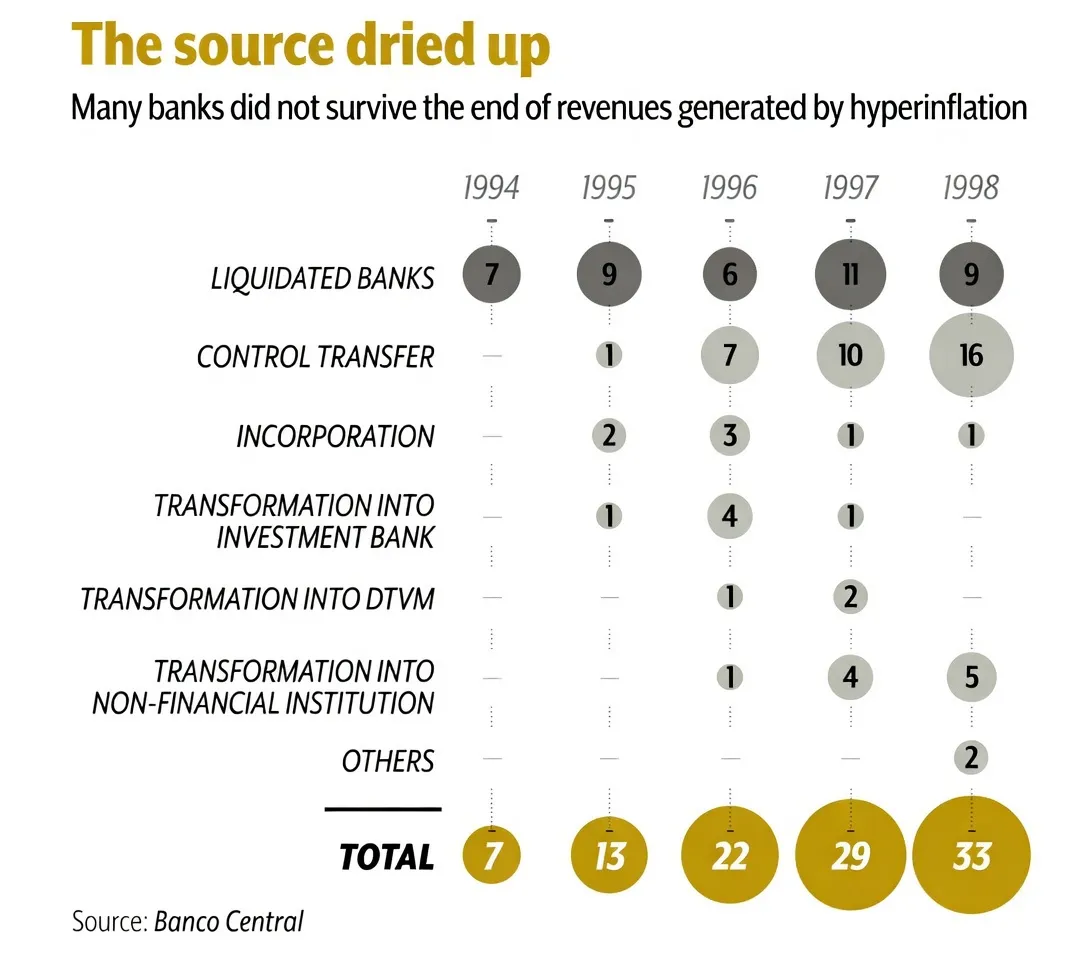
With annual inflation near 2,500%, bank returns on equity reached 12.3%, up from 8.9% in 1992. Those profits rested heavily on the overnight market and the inflationary float. Banks benefited from multi-day delays in transfers — the floating. While money was in transit, they placed it in ultra-short-term overnight operations that paid inflation plus interest and kept the gain. The arrangement ended suddenly in mid-1994. Monthly inflation, still 47.5% in June, fell to 6.8% in July once the real entered circulation. The easy gains vanished. Between 1994 and 1998 the Central Bank intervened in more than a hundred public and private banks; 42 were liquidated [2]. Institutions that had lived off the float now had to rebuild around fees, stricter credit analysis, and actual intermediation.
Some thirty years later the float has returned, only to die another death. This time, it’s not on the bank balance sheet, but at the POS, through Brazil’s incoming VAT reform known as the Split Payment system. The reform's stated aim is closing a tax evasion gap estimated at anywhere from R$417 billion (IBPT, 2020) to R$626 billion (Sonegômetro, 2022), depending on the methodology and year measured [3, 4]. Then-Planning Minister Simone Tebet cited a mid-range figure of R$500 billion to Congress in 2023 [5].
The Split Payment scheme is 170 times the daily transaction volume of PIX, which itself processes over 300 million operations a day. It is set to collect new taxes on products and services in real time, processing invoices and cross-referencing them against data on products, issuers, and tax credits. Then, those resources will be paid out between the federal government, states and municipalities. Between 2027 and 2033, the soon-added Contribution on Goods and Services (CBS) and the Tax on Goods and Services (IBS) will progressively replace IPI, PIS, Cofins, ICMS and ISS [6].
In theory, the price of the product or service for the customer won’t change under this new system. In practice, prices could rise since it wipes out the shock absorber that smaller operators use to bridge pay periods. These micro, small and medium-sized companies whose operating cashflow is directly affected may face further strain if they opt for the Simplified Procedure as their preferred model of retention.
While a Standard Procedure — which will be the norm — would calculate taxes at an exact amount for that specific transaction, a Simplified version would estimate the retention value based on the business sector. If the bank retains more than necessary, the government must eventually refund the difference; if it retains too little, the company is responsible for paying the remaining balance. A major concern with this model is that it may frequently retain more cash than the company actually owes, leaving the business with less working capital while waiting for a government refund. According to Finance Minister Dario Durigan, tax credit restitution would take up to 90 days to resolve. Other estimates put the timeframe at anywhere between 30 days and 180.
Banks, for their part, are already angling for a cut of what remains: part of their proposed compensation for operating the system would come from the brief window the tax money sits with them before reaching the government [7]. It’s the same floating mechanism that vanished from their balance sheets in 1994, reappearing now in miniature.
Brazil used a similar technical bridge in 1993–94 with the Unidade Real de Valor (URV). Running alongside the old cruzeiro real for months, the URV allowed prices, wages, and contracts to be quoted in a stable unit before the real fully replaced the old currency. The URV was the leading edge of the fourteenth stabilization attempt since 1979, emerging in the aftermath of plans that relied on freezes, confiscations and sudden conversions. By hiding the technical machinery inside the unit itself, the URV was designed to make the currency switch simple for ordinary people [8].
Something similar is now being asked of the tax system: while the new CBS and IBS phase in alongside the old taxes, Split Payment will act as the real-time bridge. Eventually, merchants will get a single invoice instead of three overlapping tax regimes (federal, state and city). But during the transition, living with both systems will squeeze their cash flow right as retentions and delayed refunds take their toll. The promise now is the same as before, with the state saying they’ll absorb the transitional complexity so the user experience looks simpler. The open question is whether that promise holds for the smallest operators.
Sources
Manchete — Uma CPI Para os Juros de 63%, February 5, 1994
Veja — Um legado duradouro: Como o Plano Real permitiu a modernização dos bancos, June 28, 2024
Agência Brasil — Brasil perde R$ 417 bi por ano com sonegação de impostos, diz estudo, December 12, 2020
Sinprofaz — Sonegômetro fecha o ano com valor superior a R$ 626 bilhões, December 27, 2022
CNN Brasil — Complexidade tributária gera R$ 500 bilhões em sonegação por ano, diz Tebet, April 4, 2023
O Globo — ‘Split payment’? Entenda o sistema 170 vezes maior que o Pix que vai redistribuir impostos sobre o consumo após a reforma, July 9, 2026
O Globo — Quem paga a conta? Bancos e governo negociam custos do ‘split payment’ na Reforma Tributária, March 6, 2026
Manchete — A História da URV: Um plano para acabar com todos os planos, March 5, 1994