Rare Earth Paradox: Rich in Resources, Poor in Processing
Brazil sits on the world's second largest rare earth reserves, 23% of the worldwide total, and can't do much with it. Of the three stages between ore and end product — mining, processing, and manufacturing — Brazil currently handles only the first. Burdened by bounty but not empowered, the country exports raw material for pennies, and imports the final product at a premium.
It sounds almost nonsensical when the raw materials exist here to produce the chemical blend known as NdPr, which are made into supermagnets that operate electric vehicles and wind turbines [1]. A single EV motor uses roughly 1–2 kg of this end product, while a large wind turbine requires several hundred kilos to over a tonne. Brazil is already ahead of schedule on green energy deployment, far beyond most other countries ⎯ yet it still has to import the components that make it work.
This is due to the difference between how much rare earth elements are present in a country, how much mining occurs there and how much refining capacity it has. In Brazil’s case, the answer is 21 million tonnes; 4,000-5,000 tonnes currently; and none at all. It’s like owning a massive apple orchard, but only picking a few baskets each year and having no processing plant, so you export raw apples cheaply and pay a premium for apple pie. No matter how you slice it, it’s a bad deal.
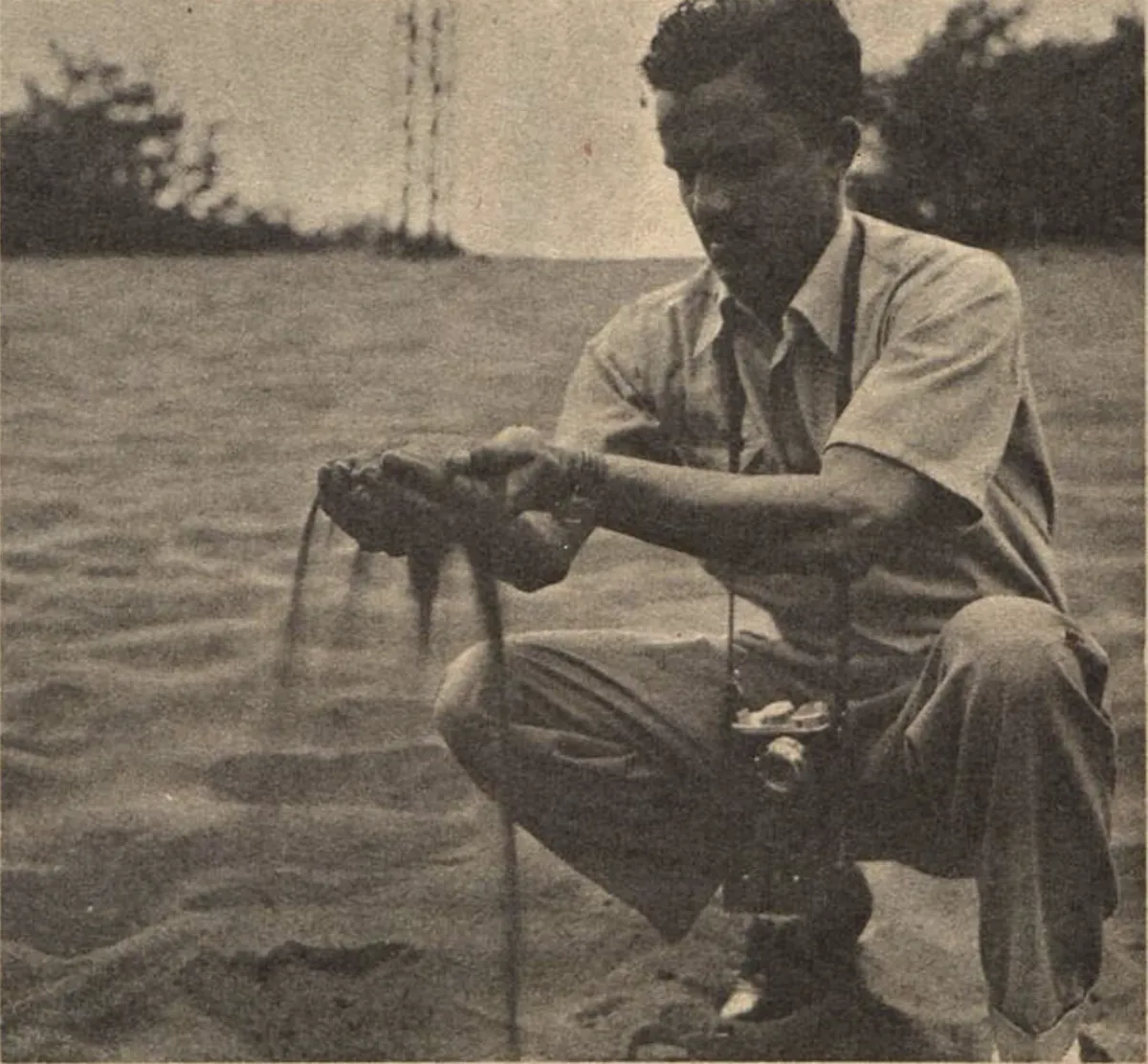
On the coast of Espírito Santo, a poor town called Guarapari was living off beach tourism and the folk belief that its radioactive sands cured rheumatism. Rich in thorium, cerium, and lanthanum, the monazite deposits meant the locals were literally lying on the future of clean energy and advanced technology, completely unaware or unbothered. By the time Manchete ⎯ Brazil’s answer to Life Magazine ⎯ ran its 1953 story on what was the country’s largest atomic mineral reserve, Brazil had already been exporting monazite raw for over half a century [2].
At its peak, between 1904 and 1910, roughly 4,000-6,000 tonnes were being exported annually, on par with today’s output. By mid-century, half of Guarapari's known reserves had already been shipped abroad. As congressman Hélio Cabal calculated at the time, the thorium contained in those exported sands represented the energy equivalent of 300 years of Brazilian consumption — sold for between US$190 and $900 a tonne, and still at a loss.
By the 1950s the processing vs. raw-export battle was already underway. Of the two dominant players — Orquima and Mibra — the former successfully pushed the government to ban exports of raw monazite sand, arguing it was 'criminal.' The law passed, but the companies simply divided the coast between themselves. Government oversight amounted to an inspector who visited every six months from São Paulo and a guard found asleep on the mineral sacks. Brazil chose the right policy on paper and still ended up with vast reserves but almost no domestic processing capacity.
A 1956 follow-up in the same magazine revealed an even more damning detail: through Orquima, Brazil had become the first country in the world to separate rare earth elements at industrial scale, exporting europium at US$8,000 a kilo as experimental material to foreign buyers. The same piece ran what it called a 'sad little headline' — Brazil lacked the technical and financial resources to use its own thorium. Not even in the near future [3].
Brazil's historical reliance on raw commodity exports isn't incidental. Research reconstructing Brazilian GDP back to 1574 suggests the extraction-export model is the economy's default setting, predating independence by centuries [4].
Rare earths are the latest iteration of something Brazil has been doing with iron ore and soy for decades. The country is the world's largest soy exporter and second largest iron ore exporter, yet neither industry ever fully moved up the value chain domestically. Vale ships iron ore abroad and imports steel; Brazil exports raw soy and buys back the processed products — animal feed, cooking oil, processed foods. As the Brazilian saying goes (recently invoked by economist Tony Volpon), Brazil doesn't miss an opportunity to miss an opportunity [5].
According to Valor International, there are 18 rare-earth projects currently in development across Brazil — a number that doubled in the last eight months. Australia's Meteoric Resources plans to process 6 million tonnes per year in Poços de Caldas, producing 14,000 tonnes of rare-earth oxides, with a subsequent $300 million separation phase planned. In Goiás, Canada's Aclara Resources initially aims for 4,300 tonnes annually, with a separation unit to be built either in the US or Brazil. Also in Poços de Caldas, Australia's Viridis Mining aims for 9,400 tonnes of rare earth oxides annually. While all three are still awaiting environmental licenses and plan to start operations in 2028, the Australian enterprises intend to fully avoid technology, components and investment from China [6, 7].
Being connected to China, from a business perspective, can both tie one to the country and repel other nations from being involved. As it stands, China handles 90% of all rare earth refining capacity as well as 70% of its production. The country is often accused of “dumping” — an unfair trade practice where a company (or country) sells a product in foreign markets at a price lower than the price it charges domestically, or even below its own production cost. In the rare earth context, China has been repeatedly accused of this practice thanks to state subsidies, lax environmental rules, and the ability of state-owned firms to absorb losses. This makes it nearly impossible for Western (or Brazilian) refining projects to become economically viable, and hints at one of the reasons Brazil’s production accounts for less than 2% globally.
Despite this challenging global environment, Brazil has ambitious clean energy goals. According to a 2025 IRENA report, the country aims to expand renewables to around 85% of its electricity mix by 2034 [8]. Without the ability to process its own rare earth elements domestically or a determined national policy that asserts sovereignty over the full value chain, Brazil risks remaining on the losing end of the energy transition. The idea behind proposals such as TerraBras1 (which Industry Minister Marcio Elias Rosa has put the brakes on) is precisely this: ensuring that what lies in Brazilian soil belongs first and foremost to Brazil, rather than being controlled by foreign companies or left at the raw-export stage [9].
As for policy, the Chamber of Deputies recently passed a bill creating the National Policy for Critical and Strategic Minerals (PNMCE), which is now moving to the Senate [10]. The bill establishes strong incentives to move up the value chain: a guarantee fund of up to R$2 billion and R$5 billion in tax credits, phased between 2030 and 2034, for companies that process and industrialize rare earths and other critical minerals inside Brazil.
Within that effort, Julio Nery, director of mining affairs at the Brazilian Mining Institute, notes that BNDES has been expanding financing for mining companies. Financing mechanisms, he argues, are the key pressure point for developing the rare earths supply chain domestically.
Experts forecast that demand for NdPr will grow by roughly 7% annually through 2030, by which point the world will likely need 97,000 tonnes — 50% more than in 2024 [11]. The minerals are there. The projects are coming. The policy is moving through the Senate. What Brazil has never quite managed is for all three to arrive at the same time, and in the right order.
Sources
G1 — Terras raras (que não são terras nem raras) colocam Brasil no meio de ‘guerra fria’ entre EUA e China; veja 10 perguntas e respostas, May 7, 2026
Manchete — Salvemos Nossa Monezítica, May 16, 1953
Manchete — Manchetinhos: De tório e outros minérios, September 22, 1956
University of Manchester — How a nation was born: Brazilian economic growth, 1574–1920, by Guilherme Lambaisa & Nuno Palmab
O Globo — Brasil na moda de novo…agora vai?, Tony Volpon, May 9, 2026
Valor International — Investment in critical minerals to reach $21.3bn by 2030, May 5, 2026
Valor International — Australian mining companies see Brazil as alternative to China in rare earths, September 18, 2025
IRENA — The energy transition in Brazil, 2025, citing MME/EPE (2024b)
Mining.com — Brazil rejects ‘TerraBras’ as US minerals deal stalls, April 24, 2026
Ministry of Mines & Energy — Strategic minerals for the energy transition, November 12, 2025
Aurelion Research — Brazil Rare Earths: A Rare Opportunity, February 25, 2026
a proposed state-owned enterprise (similar to Petrobras) designed to give Brazil control over the full value chain of rare earths and strategic minerals↩