The Price of Not Reading: The mail-order system that made Brazil a nation of readers
In early-1970s Brazil, a common explanation for low readership went like this: books are expensive because few people read, and few people read because books are expensive. A distribution problem no one had solved was masquerading as cultural indifference.
Created in 1973, Círculo do Livro (CdL) was the most successful attempt to break out of that loop. In fact, it was the largest “book of the month” club in 20th century Brazil. Formed by the German behemoth Bertelsmann and Brazil’s Abril publishing houses, it operated as a mail-order subscription service where its 800,000 members read up to four million titles a year. This was accomplished by regular catalogs sent through the mail where members paid an initiation fee and had to choose at least one book, from a selection of more than 500 titles, every few months to remain active. The in-house magazine, or rather “magalog”, Revista do Livro, was also included in the subscription, free of charge, and it doubled as the book catalog.
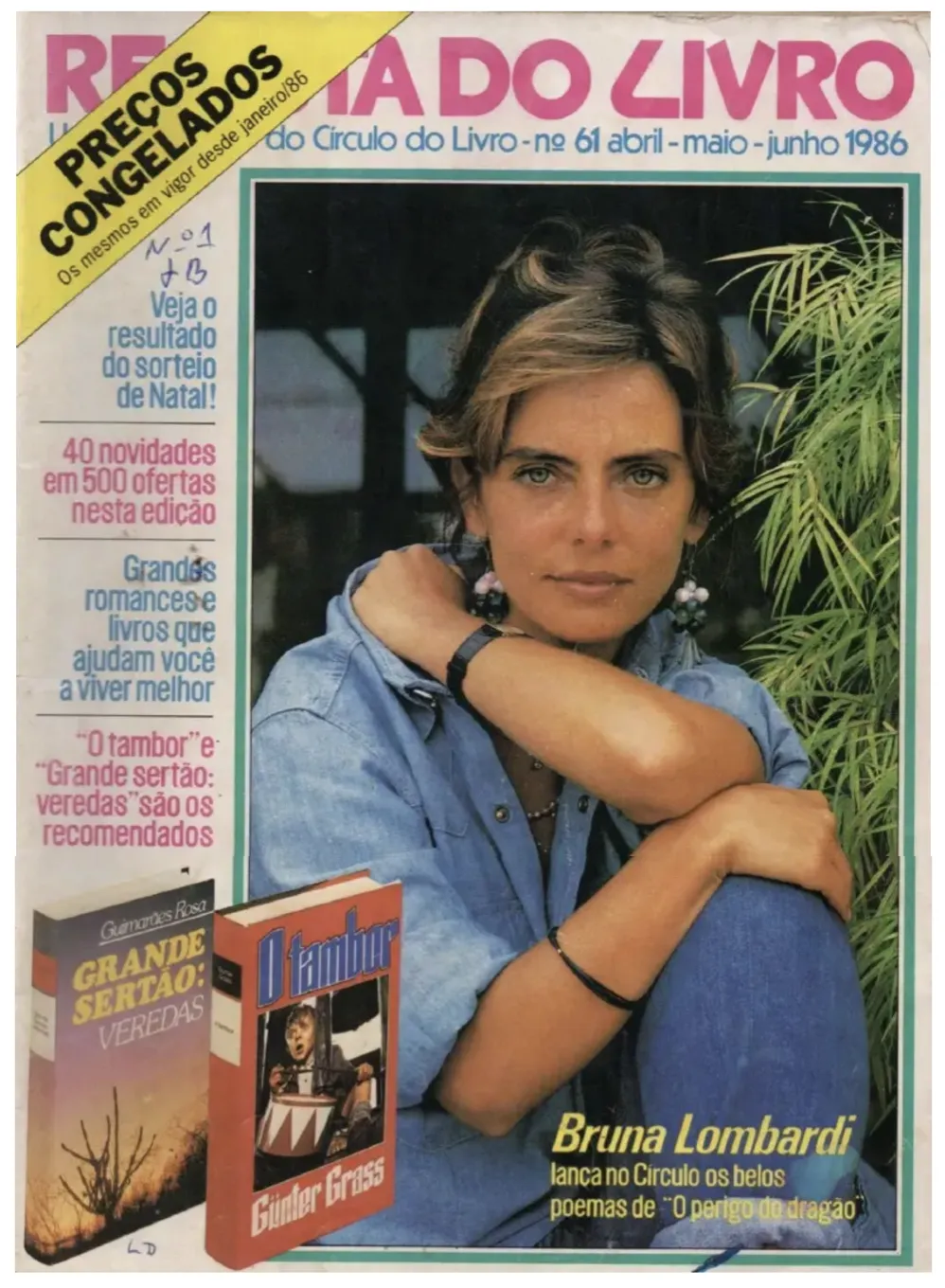
With prices that undercut bookstores, the CdL spread rapidly across Brazil in the 1980s, with its 2,000 vendors who delivered the books and collected payments (in the case the reader didn’t wish to receive them by snail mail). In the 1990s, a few years prior to closing down, they had expanded to selling music in the form of CDs with a catalog called The Music Circle.
So how did CdL sell books for cheaper? In simple terms: economies of scale. According to Jornal do Brasil, the typical cost to the reader in 1974 prices - if using a book from the famous series Civilização Brasiliera as an example - was Cr$19 versus the normal retail price of Cr$25 at a newsstand. In 1988, while the paperback edition of the novel A Fogueira das Vaidades cost the average reader around Cz$ 12,0001, a typical art book with a hardcover was just Cz$ 2,900 via subscription.
Publishers at the time were married to the industry’s standard financial model, and CdL was there to take advantage of that. For the average publishing house, figuring out their sales price revolved around multiplying their industrial cost by five. A book that cost Cr$10 to make was simply sold for Cr$50, more or less equally divided among the production cost, the author, administrative bills, and profit for the editor. Additionally, since CdL could predict both sales and printing volume based on orders, their stocks weren’t just lying around for unlimited periods. Regular publishers had to treat unsold inventory as part of their taxable assets, and the corporate income tax rate was 30% on profits.
This partly explains why CdL was so successful - not merely as a publisher, but as the standout among book clubs. Other reasons include its sheer size. By the late 70s, it had its own printing press, 13 branch offices throughout the country, 900 employees and published 80-100 titles per year. Even poets - which are typically a hard sell - were doing good numbers through CdL.
Círculo do Livro, however, wasn’t the first of its kind. Brazil's book-club lineage runs back to 1941, when Mário de Andrade, Cândido Portinari, and Aníbal Machado founded a poetry club, followed a year later by the Sociedade dos Cem Bibliófilos do Brasil, which published 23 titles before closing in 1968. Two more clubs, O Livro do Mês and Círculo Literário, appeared in the same decade, and Mário Graciotti's Clube do Livro — which later attempted to compete with CdL — followed in 1943 [2].
Even though these kinds of clubs found their respective audiences in Brazil, the idea for them often always originated in Europe where, of course, the printing press was invented. Even in the case of the Círculo do Livro, it was the German publisher Bertelsmann that sought out other markets to replicate the success it found in Germany, Spain2 and Portugal. The Sociedade was no different, in that it also took its inspiration from European practices. As for the second book club of its kind, it was made up of 100 prominent figures of the time who met up to produce major works of Brazilian literature, illustrated by renowned artists. Distinct from modern book clubs open to the public, the Sociedade only printed enough copies for its distinguished members.
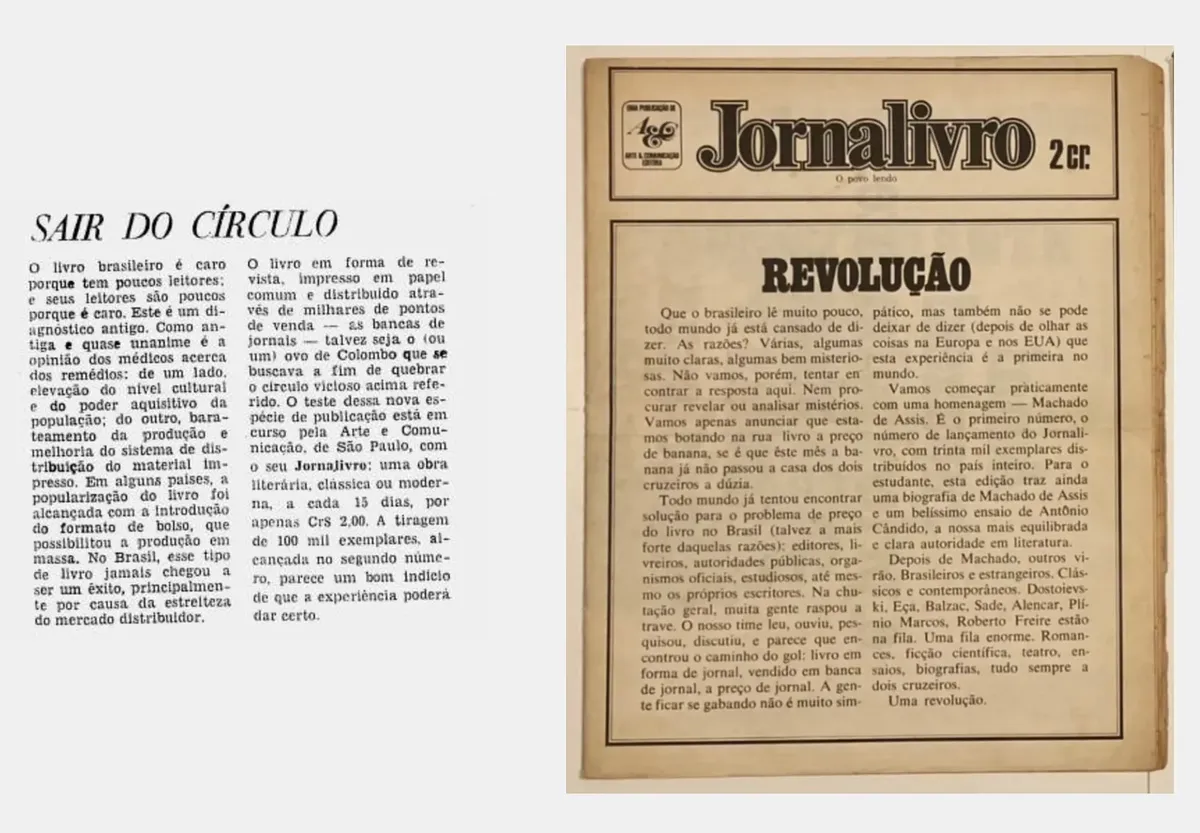
One year before Círculo do Livro formally entered the market in 1973, Jornal do Brasil published a short piece titled Sair do Círculo (“Leave the circle”), reflecting a growing awareness of the structural limits of Brazil’s book market. Rather than treating low readership as a cultural failing, the article pointed to the mechanics that kept books out of reach for much of the population. In the same piece, the paper highlighted an emerging experiment out of São Paulo called Jornalivro3 which offered readers a new title every fifteen days - classics and contemporary works alike - for just two cruzeiros (Cr$2). Its secret recipe was fairly simple: “a book in the format of a newspaper, sold at a newsstand, at the price of a newspaper”. By its second edition, the project had already distributed a promising 100,000 copies.
The numbers that outfits like Jornalivro were doing in the early ‘70s, and that CdL would soon be doing too, shed a light on the true market of Brazil’s reading public, at least in the bubble of that time and place.
Reading cultures rarely vanish on their own. They weaken when the paths that connect readers to books become narrow, expensive, or fragile. In Brazil’s case, demand existed well before it was formally acknowledged, and it surfaced whenever pricing, distribution, and incentives aligned with everyday life. What looked like a cultural shortcoming was largely a question of access.
Círculo do Livro worked because it treated reading as a logistical problem rather than a moral one. By lowering costs, predicting demand, and meeting readers where they already were, it revealed a public that was willing to read widely when given the means to do so4. When that system disappeared, so did the conditions that made large-scale reading ordinary.
Sources
Gazeta do Povo — Círculo do Livro, April 22, 2015
Comunicom ESPM — Círculo do Livro: Os Rastros de Memória do Maior Clube de Assinatura de Livros Brasileiro no Séc. XX, 2021
O Globo — Cem Bibliófilos do Brasil: Abertura, September 21, 2022
Revista Tempo & Argumento — Entre livros e memórias: a web como lugar de nostalgia do Círculo do Livro, 2021
Cz$ isn’t a typo. Cr$ is the cruzeiro and Cz$ is the cruzado↩
the Spanish version, Clube de Lectores, closed only in 2019↩
it was apparently shut down by the censorship apparatus of the Brazilian dictatorship and seems to have reopened as a strictly political paper in the early 1980’s↩
Street interview with average Brazilians about their reading habits and preferences, Rio de Janeiro [YT, 1976, 3m39s]. Portuguese only, no subtitles — but worth watching even without the language: the fluency, calm, and range of titles cited by ordinary interviewees is its own kind of evidence↩